Friday, June 28, 2013

Charles Hedrich shares a video about shipping his rowboat named "Rowing Ice" from France to Wales Alaska


Le Rameur des Glaces voyage sur le Manguier... por respectonslaterre


Rower Ice is ready to launch an assault in the Arctic. Transported from Paris to the United States in shipping container, then by train to Alaska, he joined the Northern Alaska aboard Tug Mango for shipping.

Discover the first images of Rowing Ice in the North: a quick overview of the beautiful scenery to come and possible encounters ...


... We are still waiting for the weather window to Wales. Stay connected while little change very quickly and launch of Rowing Ice arrives soon!

Is Arctic Permafrost the "Sleeping Giant" of Climate Change?

Flying low and slow above the pristine terrain of Alaska's North Slope research scientist Charles Miller of NASA's Jet Propulsion Laboratory surveys the white expanse of tundra and permafrost below. On the horizon, a long, dark line appears. His plane draws nearer, and the mysterious object reveals itself to be a massive herd of migrating caribou, stretching for miles.

It's a sight Miller won't soon forget.


"Seeing those caribou marching single-file across the tundra puts what we're doing here in the Arctic into perspective," says Miller, who is on five-year mission named “CARVE” to study how climate change is affecting the Arctic's carbon cycle.

A new ScienceCast video peeks beneath the topsoil to inspect the carbon stores of Arctic permafrost.Play it

ScienceCasts: The "Sleeping Giant" in Arctic Permafrost


CARVE is short for the “Carbon in Arctic Reservoirs Vulnerability Experiment.” Now in its third year, the airborne campaign is testing the hypothesis that Arctic carbon reservoirs are vulnerable to warming, while delivering the first source-maps of greenhouse gases carbon dioxide and methane. About two dozen scientists from 12 institutions are participating.

"The Arctic is critical to understanding global climate," says Miller. "Climate change is already happening in the Arctic, faster than its ecosystems can adapt. Looking at the Arctic is like looking at the canary in the coal mine for the entire Earth system."

Over hundreds of millennia, Arctic permafrost soils have accumulated vast stores of organic carbon - an estimated 1,400 to 1,850 billion metric tons of it. That's about half of all the estimated organic carbon stored in Earth's soils. In comparison, about 350 billion metric tons of carbon have been emitted from all fossil-fuel combustion and human activities since 1850. Most of the Arctic’s sequestered carbon is located in thaw-vulnerable topsoils within 3 meters of the surface.

But, as scientists are learning, permafrost - and its stored carbon - may not be as permanent as its name implies. And that has them concerned.

"Permafrost soils are warming even faster than Arctic air temperatures - as much as 1.5 to 2.5 degrees Celsius in just the past 30 years," says Miller. "As heat from Earth's surface penetrates into permafrost, it threatens to mobilize these organic carbon reservoirs and release them into the atmosphere as carbon dioxide and methane, upsetting the Arctic's carbon balance and greatly exacerbating global warming."

CARVE campaign flights are conducted aboard a specially instrumented NASA C-23 Sherpa aircraft from NASA's Wallops Flight Facility on Wallops Island in Virginia. The C-23 won't win any beauty contests - its pilots refer to it as "a UPS truck with a bad nose job." Inside, it's extremely noisy - the pilots and crew wear noise-cancelling headphones to communicate. "When you take the headphones off, it's like being at a NASCAR race," Miller quipped.

But what the C-23 lacks in beauty and quiet, it makes up for in reliability and its ability to fly "down in the mud." Most of the time, it flies about 150 meters above ground level, with periodic ascents to higher altitudes to collect background data. Onboard the plane, sophisticated instruments sniff the atmosphere for greenhouse gases. "[We] need to fly very close to the surface in the Arctic to capture the interesting exchanges of carbon taking place between Earth's surface and atmosphere," Miller says.

The CARVE team flew test flights in 2011 and science flights in 2012. So far in 2013 they have completed three monthly campaigns--in April, May and June--with four more to go.

From a base in Fairbanks, Alaska, the C-23 flies up to eight hours a day to sites on Alaska's North Slope, interior and Yukon River Valley over tundra, permafrost, boreal forests, peatlands and wetlands.

Soaring over the Arctic terrain, Miller has seen many things he won’t forget. The permafrost data may prove unforgettable, too.

Credits:

Production editor: Dr. Tony Phillips | Credit: Science@NASA

More information:

Carbon in Arctic Reservoirs Vulnerability Experiment home page


Thursday, June 27, 2013

TheLastFirst Expedition - Do they have the RIGHT STUFF? Not likely and here is why...

TheLastFirst.com:

The right stuff? Doubtful... here is why...

  • The ARCTIC JOULE is not seaworthy, nor will it auto-right itself if capsized. The video at http://vimeo.com/65757435 has been re-edited and the portion from 00:31 to the end has been removed which illustrated that the rowboat would not roll-over if capsized. An upside down boat is a disaster - here is what happened to another ocean rowboat which capsized - http://news.nationalpost.com/2013/04/08/canadian-olympians-trans-atlantic-expedition-cut-short-after-rowboat-capsizes/
  • The ARCTIC JOULE is not outfitted for Arctic weather and will likely cause the four men to become ill with respiratory illness requiring medical treatment. This could present life threatening evacuation or rescue.
  • You never see the rowers wearing a personal flotation device (PFD, i.e. lifejacket). This single factor is why most people lose their life out on the water. The cold Arctic water will make hypothermia another real threat.

Rowboat Capsized, Men Rescued off Richmond Beach - repeated errors...

  • Witnesses on the beach called 9-1-1 and told KIRO that the men were not wearing lifejackets.
  • Limit the loads of people and equipment carried in boats. Overloaded boats are less maneuverable and more likely to become swamped or capsized.
  • Dress for the water temperature, not the air temperature. Assess the wind and wave conditions to decide if you are prepared for potential cold-water conditions.

http://shoreline.patch.com/groups/police-and-fire/p/rowboat-capsized-men-rescued-off-richmond-beach

  • The rowboat hatches are shown OPEN while underway which is a classic safety issue knowing that a sneaker wave can roll the boat over and the open hatches will surely enable flooding and sinking of their only shelter. The first rule of survival is SHELTER.
Continued mis-representations, become known as willful lies.

  1. The Northwest Passage is a sea route of some 3,500 miles, depending on which of the seven routes navigated between specific geographic points. To complete a Northwest Passage the vessel must cross the starting and finish lines and travel the entire distance on its own bottom between the Bering Strait's Arctic Circle and Davis Strait's Arctic Circle. Depending on direction of travel the vessel crosses the Atlantic Ocean and Pacific Ocean Arctic Circles (Latitude 66.5622°N)  Expressed another way you do not get credit for climbing Mount Everest unless you summit the top of the mountain. Start and Finish lines. You don't get to make up the rules or change them - not after 107 years and 185 transits.
  2. Hamlet to hamlet trips of only 1,500 miles between Inuvik and Pond Inlet does not represent a Northwest Passage but rather a short point-to-point trip.
  3. TheLastFirst will not be the first to row in the Arctic. Mathieu Bonnier rowed solo from Greenland to Cambridge Bay in 2010-2011. Other rowers have also rowed in the Arctic.
  4. Charles Hedrich completed a Northwest Passage by yacht in 2009. Today he is waiting for better weather in Wales Alaska with his son to start rowing a full Northwest Passage transit in 2013. This could be the FIRST official rowboat Northwest Passage. Bering Strait to Davis Strait - Arctic Circle to Arctic Circle. Start to finish line.
  • Will rowing in the Arctic make people more aware of melting Arctic ice? The Arctic is actually colder in 2013 than in 2003. The ice is NOT diminishing but rather growing larger... Does the melting of ice make navigation of the Northwest Passage possible? It depends... on your point of reference... but in the last 107 years 135 vessels have completed a full 185 Northwest Passages, some vessels multiple times. Surely in 107 years it was not because of melting ice but rather the desire to win the ultimate Arctic challenge to navigate between Atlantic Arctic Circle to Pacific Arctic Circle through the Arctic Archipelago. Will the ARCTIC JOULE row between Inuvik and Pond Inlet because of melting ice? Definitely not. Only because four men have enough strength, a break in the weather and can overcome the dangers along the way. Will anyone change to renewable resources because of someone rowing in the Arctic? Not likely, but I suspect a few bone heads will use this opportunity to proclaim they are going "GREEN." You can bet the four rowers will all continue to drive their carbon guzzling cars... unless Mainstream RP awards them electric cars... how about more investment MRP?
  • Anyone that thinks TheLastFirst is a world record is encouraged to ask GUINNESS WORLD RECORDS to certify their transit. Please post a daily position by SPOT GPS beacon (findmespot.com) (not by a webmaster handcrafting a bogus track map) and post a copy of your ship's logbook for inspection - a public blog site is a good basis.

Can TheLastFirst make a difference? Not likely at all... NO!

"Exxon Mobil executives care less about Americans’ belief in climate change, Coll suggests, than they do about Americans’ belief in punitive damages from lawsuits. After the next Exxon Valdez spill, or the next Jacksonville spill (in which an Exxon service station leaked 24,000 gallons of gasoline into a Maryland community’s water supply), what a jury decides could subtract billions from the bottom line. Small wonder that after the Valdez, a company representative quietly called a University of Wisconsin professor to offer money if he would write an article for a “respectable academic journal,” arguing against punitive damages. This man spoke up, but we don’t know how many other scholars received and may have acted on the same offer and said nothing." (PRIVATE EMPIRE By Steve Coll)

Liquid carbon called 'oil' is spilled every day on planet earth - preventing oil spills would be a giant step forward... reducing our addiction to oil with renewable power such as solar makes very good sense...  but when you learn that Exxon has been in business for more than 100 years, has seen 19 U.S. Presidents come and go and has remained an extremely lucrative and powerful business... with an attitude described as F_ _ _ you - no apologies, oil is here to stay. 


You realize that TheLastFirst is a grain of sand on the seashore unable to make a difference from rowing in the Arctic - why is Mainstream Renewable Power (MRP) not offering incentives on alternative power products which provide renewable power for centuries instead of funding some $250,000 for a dare devil rowboat crew in the Arctic... because CEO Eddie O'Connor is looking forward to greeting the lads at one of the Arctic hamlets as a great funded vacation just like the four lads rowing the boat in the Arctic - it is a free TheLastFirst adventure? The lads surely didn't mortgage their homes to participate or contribute anything except their time to row. All expenses are paid by sponsor MRP? It will likely be “Adventure is just bad planning.” repeated over and over again... four lads rowing in the Arctic is nonsense. 

Are you going to do anything different because of four lads rowing in the Arctic? Please comment below and tell us what YOU ARE DOING BECAUSE OF THIS and WHY.

Lets see if four lads in a rowboat have the RIGHT STUFF? To return home safe and well without risking rescue and loss of life. That would be so sad should it happen but where else are the odds so high as in the extreme Arctic - you have to be touched to even attempt such a dare devil event - mother nature does not give second chances in her remote deep freezer.

God Speed Arctic Joule and her crew!


Better yet - here is what makes sense... 

Rowboats for Retirement


At 48, Kevin Vallely jokes that he is the “old man” on the four-member crew that is about to attempt a human-powered crossing of the icy Northwest Passage.

Here’s what Kevin Vallely’s packed for his summer boating trip: 640 two-serving dry food meals, 960 packets of oatmeal, 700 power bars, 700 chocolate bars, 20 pounds of coffee, 500 packets of ramen noodles, 15 pounds of beef jerky and 360 packs of multivitamins.
OK, so it’s more of a voyage than a boat trip — and he’s not eating alone. On July 1, the North Van adventurer and three teammates — Paul Gleeson, Frank Wolf and Denis Barnett — will attempt to row the Northwest Passage, from Inuvik through the Canadian Arctic Archipelago and all the way to Pond Inlet, Nunavut, in a four-man row boat.

No sails, no motors — just human power. ETA is 75 days.

“This has been on the books for a long time,” he says of the sea expedition. 
Fifteen years ago Vallely and a paddler friend were discussing the subject of “the last firsts left to do.”

“Everest has been climbed, South Pole, North Pole — everything,” says Vallely, a father of two who is a Lynn Valley-based home designer by day.

They talked about the historic and daunting Northwest Passage.

“Northwest Passage solely under human power in a single feat was, by far, a great first that was still undone but there was no way it could be done 15 years ago. You know fifteen years ago you needed a steel-hulled icebreaker to make it across the Northwest Passage.”

The only reason they can even attempt the crossing today is because of climate change, he says.
And that’s the overarching message of this modern-day nautical expedition.

“We want to make a really strong statement here in that the only reason we can do this darn thing is because of climate change,” says Vallely, whose team’s main sponsor is Mainstream Renewable Power.

This isn’t Vallely’s first big adventure. He’s tackled Alaska’s Iditarod Trail and trekked from Hercules Inlet to the South Pole, among many other wild endurance-based expeditions in far-flung places. 
His latest adventure, he says, ranks at the top of his challenge-o-meter thus far.

“There’s a lot of unknowns with everything,” says Vallely, 48.

For instance when he and a team set a world record racing to the South Pole, others had preceded them and documented the experience. “I could read about it, figure it out. Anticipate things. Nobody has ever done this before.”

Still, he’s optimistic they will conquer the ice-riddled passage.

“Hopefully 75 days later we will pop out. ”
Of course, there will be danger lurking at all times.

“Ice and wind. Ice is nasty up there and it’s big and it’s mean and it moves around fast,” he says. “We’re in a very vulnerable boat so we have to be very careful as we poke along. It’s not just like crossing water, it’s water with a lot of obstacles in it.”

In terms of safety preparation, they will be equipped with state-of-the-art navigation equipment, an emergency raft, survival suits and beacons. The boat itself is made with layers of Kevlar, fibreglass and foam “to accept a bit of a bang with the boat with the ice.”
Each member of the crew has wilderness first-aid training and they’ve got an ICU doc on call for the duration of the trip who has outfitted them with a comprehensive medical kit.

“We don’t want to be calling for help when we are out there, even if that means poking along slower than we may like; we’re going to do it safely. It’s a very remote location and we don’t want to risk anyone else trying to save us.”

To prepare for the marathon voyage, Vallely has been a fixture on the rowing machine at Karen Magnussen rec centre for months.

During the trip, the plan is to have two teams of rowers rotating every four hours.
“Four hours is required for a true rest,” he explains.

Not that there will be much of that. When not rowing, the members will be writing blogs and journal entries as well as photographing and filming their experience. They will also be collecting data for Department of Fisheries and Oceans.

And while their rowing trip will most certainly be a grind at times, the crew should remain in fine spirits.

“We do have six bottles of single malt as well, its not all misery at sea,” says Vallely. 


To follow the progress of the Expedition, go to findmespot.com at:
http://share.findmespot.com/shared/gogl.jsp?glId=0iRTKLUZYPqVvo9fjJlhupoJlQx9xQgLG

http://www.northshoreoutlook.com/news/213176961.html

Now compare this Charles Hedrich video with any of TheLastFirst videos - do you see the BIG DIFFERENCE - there are men prepared for the Arctic and there are those who say they are...lol

How to live on Mars? Practice on Devon Island in the Arctic


MARS ARCTIC 365 
The Mars Society’s one-year Mars surface simulation mission in northern Canada.

"It's been 44 years since we stepped on the lunar surface, and I think the progress since then is a little slow. I've always felt that Mars should be the next destination following our landings on the Moon. I want the next generation to feel as we did back when I was privileged enough to be a part of the Apollo program."
   -- Dr. Buzz Aldrin, Apollo 11 Astronaut and Mars Society Steering Committee Member


Website: http://www.marssociety.org/

Mars Society Announces High-Level Science Team for Mars Arctic 365 Simulation

posted Jun 13, 2013, 9:37 AM by Mars Society - PR [ updated Jun 13, 2013, 2:36 PM ]

Several weeks ago, the Mars Society announced that it was initiating a ground-breaking project known as Mars Arctic 365, a special one-year Mars surface simulation mission to take place at the Flashline Mars Arctic Research Station (FMARS) on Devon Island in northern Canada.


The Mars Arctic 365 program, scheduled to begin in the summer of 2014, will provide scientists with the most extensive testing to date on how a multi-person crew can live and work together under isolated, stressful and harsh conditions as part of a human mission to the Red Planet. 

Given the importance of this scientific endeavor to the planning for a humans-to-Mars expedition, the Mars Society had recruited a high-level team of experts to design and manage the science program that will be carried out during the year-long simulation. Areas of research will include geology, microbiology, human physiology and psychology, nutrition-food studies and field technology studies, to name a few.
Crew Announced for Mars Arctic 365 Mission (Phase 1)
The Mars Society announced today the selection of nine crew members chosen to participate in the Mars Arctic 365 mission (Phase 1) this July at the Flashline Mars Arctic Research Station (FMARS) on Devon Island in the Canadian High Arctic. This will be the thirteenth crew to inhabit the FMARS facility since its establishment in July 2000, continuing the Mars Society's pioneering work in organizing sustained field exploration while operating under Mars mission constraints.


Scheduled to be in Canada for two weeks, the new crew will install key equipment and infrastructure and also upgrade systems needed to support the one-year Mars surface simulation expedition (Phase 2), which will begin in the summer of 2014. The visit to FMARS is also expected to include a limited duration Mars simulation exercise to provide crew members with an opportunity to gain first-hand experience with technical and human factor considerations which are likely to be faced by the first human explorers to the Red Planet.
The following nine people will make up the Mars Arctic 365 (MA365) mission crew for July 2013:

Joseph Palaia (Orlando, FL)

Mr. Palaia is the MA365 Crew Commander (Phase 1) and is a FMARS veteran who served as Executive Officer on the most recent Mars Society expedition to Devon Island in July 2009. He is also Chief Operating Officer of Earthrise Space Inc.

Dr. Alexander Kumar (Oxford, UK)

Dr. Kumar is a British medical doctor and experienced scientific explorer, who spent one year at Concordia Station in Antarctica and also organized the White Mars field study for Sir Ranulph Fiennes’ Coldest Journey expedition across the southern continent. Dr. Kumar will serve as Principal Investigator of the MA365 mission and is a member of the project’s science team.

Adam Nehr (Orlando, FL)

Mr. Nehr is a veteran engineer experienced in electro-mechanical design and image system operations, who will serve as MA365 Executive Officer and Engineer (Phase 1). He is also Senior Manufacturing Engineer for Earthrise Space Inc.

Justin Sumpter (Orlando, FL)

Mr. Sumpter will serve as IT Specialist for the MA365 expedition (Phase 1). At present, he works as Senior Systems Administrator for Earthrise Space Inc.

Barry Stott (Chadds Ford, PA)

Mr. Stott is a veteran pilot and owner of several aircraft charter firms. He will serve as one of the pilots during the MA365 July mission. He is also a life-time Mars Society member and one of the major sponsors of the MA365 summer expedition.

Dr. Richard Sugden (Driggs, ID)

Dr. Sugden is a family medical doctor and an experienced pilot who owns Teton Aviation. He will serve as one of the pilots during the MA365 July visit to FMARS.

Richard Spencer (Wilson, WY)

Mr. Spencer is an experienced aviator who will fly one of the aircraft during the MA365 summer mission. He is also a former investment banker and headed several major investment firms. In addition, he served as a naval pilot in the U.S. Marine Corps.

Garrett Edquist (Glenwood Springs, CO)

Mr. Edquist will serve as the crew videographer during the summer mission on Devon Island. He is experienced in filming and producing short-form films and documentaries and holds the position of Editor at Summit Films Inc.

James Moore (Farmington, CT)

Mr. Moore is an experienced photo-journalist who serves as Associate Editor of Aircraft Owners and Pilots Association (AOPA). Mr. Moore is being dispatched by AOPA on editorial assignment to cover the MA365 summer mission.

To read the full announcement, please click here.


Where a Head of Cabbage Costs $28.54 - ARCTIC CANADA

ARCTIC CANADA FOOD PRICES ARE OUT OF CONTROL!
"Old Mother Hubbard went to the cupboard to get her poor dog a bone. But when she got there, the cupboard was bare..."
There is a place where Old Mother Hubbard's predicament is a fact of life. In this place, 70 per cent of pre-school children do not have daily access to nutritious food, and 60 per cent of adults said there are days their family has no food at all. Children forage in dumps for expired food discarded by stores.
We've seen food insecurity in many parts of the developing world. However the place we're talking about isn't in the developing world -- it's in Canada.


The rate of food insecurity in Canadian Arctic communities is six times the national average, according to Inuit Tapiriit Kanatami (ITK), an organization that represents Canadian Inuit. It is the highest rate of food insecurity in the world for an Aboriginal people living in a developed country. The World Health Organization defines food insecurity as a lack of access to "sufficient, safe, nutritious food to maintain a healthy and active life."
More compelling than statistics are the stories and photos on the Facebook page "Feeding My Family." A single mother says she goes without meals so her children can eat; parents keep their kids home from school because they don't want to send them on an empty stomach; a family admits to visiting relatives just to get a meal.


Inuit cousins Leesee Papatsie and Eric Joamie were outraged with the hunger prevalent in their communities. They turned to Facebook to give Inuit communities a voice and make the rest of Canada aware of the food crisis they face. Within 10 days of its debut, "Feeding My Family" had gained more than 10,000 Facebook followers.
Papatsie and Joamie believe Canadians would be shocked to learn what food costs in Canada's Arctic territories. We certainly were shocked when we visited Iqaluit, but even more so by the photos posted by Inuit shoppers in other communities in Nunavut's Baffin region. The price label on a head of cabbage in Arctic Bay was $28.54; the tag below a flat of six cans of concentrated orange juice in Igloolik read $51.89, and a 24-pack of bottled water in Clyde River was a mind-blowing $104.99!
Food is expensive because it must be flown in to remote communities from cities such as Winnipeg, Montreal and Ottawa. A federal government program--Nutrition North Canada--provides subsidies for some food products. However the Nunavut and the Northwest Territories governments say consumers are not benefitting from the subsidies and have called for the Auditor General to investigate the program.
High food prices devastate Inuit families. According to a study published by the American Society for Nutrition in 2012, the average weekly cost of groceries for a family of four is $380. The study found that almost half of Inuit adults earn about $20,000 a year, but shell out more than $19,000 annually for food.
Papatsie explained this leads to a vicious cycle where one grocery bill devours most of a paycheque so people must borrow to make it to the next payday. Come that payday they must pay off the debt, leaving even less money to buy food and creating the need to borrow even more. In Jaomie's community of Pangnirtung, 300 km north of Iqaluit, people phone radio talk shows pleading for listeners to loan them money or donate food.


The only reason people haven't starved, said Papatsie, is because the Inuit communities traditionally share with those in need, and because they can hunt to make up the shortfall.
But even hunting may soon fail to meet the desperate need. The cost of buying and maintaining hunting equipment and the snowmobiles necessary for travelling far out onto the tundra can be tens of thousands of dollars--out of reach for many, Joamie said. And for those who are able to hunt, the chances of finding game are decreasing. According to the ITK, over the last 20 years Nunavut and the Northwest Territories have seen a reduction in caribou herds--one of the primary traditional Inuit sources of food--with population declines as high as 95 per cent in some areas.
The food situation in Canada's Arctic is garnering international attention. On the "Feeding My Family" Facebook page people from around the world express shock that such a situation could exist in a developed country. Last December, the United Nations Special Rapporteur on the Right to Food criticized Canada for failing to adequately address Inuit food security.
The Government of Canada must work with Arctic communities to ensure that programs intended to provide affordable access to nutritious food actually work. And Canada is long overdue in developing a national food policy that recognizes access to food as a basic human right.
In a rich country like ours, Mother Hubbard should be a nursery rhyme, not a real-life horror story.


Wednesday, June 26, 2013

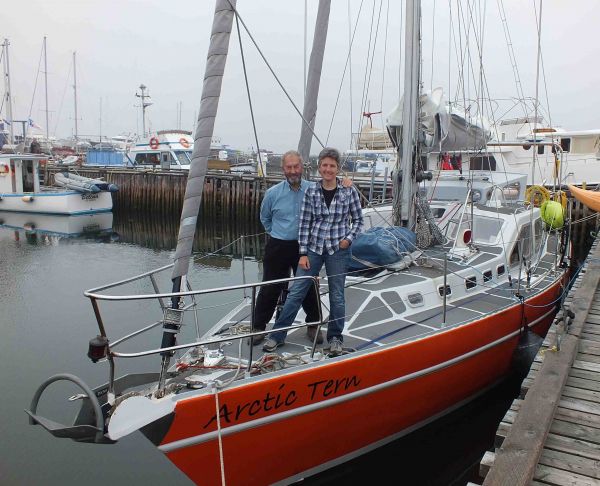
Sailboat ARCTIC TERN staging from Newfoundland for east to west Northwest Passage 2013 challenge

Several pictures from their blog to start... looks like it will be a well documented Northwest Passage... can't wait. Their story begins below...

(Click any picture for a larger size image)


Les and Ali Parsons left their home in North Wales, United Kingdom in October of last year and travelled to Lewisporte to prepare for the trip of a lifetime in their sailboat — the Arctic Tern.

The couple will spend the next five months navigating their way to Greenland and from there through the Northwest Passage. The Northwest Passage is a water route in the Arctic Ocean through the Islands of Northern Canada that connects the Atlantic and Pacific Oceans. Up until recent years it had been impassible due to heavy pack ice, but climate change has reduced the pack ice making the passage navigable.

The Parsons left the Lewisporte Marina on June 18 with enough supplies to last them throughout their journey.

Mr. Parsons said, “It should take us about nine days to get to Greenland (from Lewisporte). We are spending one month there working with scientists completing research on bird species.”

Before they leave Greenland the couple will pick up additional supplies that are flown into Greenland from Denmark. They will also be joined by four additional crew members — one of them being their son — in Upernavik.

The Parsons have their sailboat equipped with GPS, radar, and an automatic identification system (AIS) that allows them to view the size and position of other shops in their vicinity on a monitor and satellite phone to aid in navigation and safety during the expedition.

Ms. Parsons said, “We still have traditional paper charts that we use as well as the modern electronic equipment.”

The Parsons anticipate it will take them about 50 days to reach Kodiak, Alaska following the historic route through the Northwest Passage.

When asked why they chose Lewisporte as a starting point Mr. Parsons said, “First of all it’s the first yacht marina as you travel south from Greenland, that’s what brings you here. It’s the helpfulness, friendliness and knowledge of boating from local people that makes you stay. It’s world-class and I have recommended the Lewisporte Marina to my friends.”

The journey of the Arctic Tern and its crew can be followed at: http://www.arcticternexpeditions.co.uk/wordpress/?page_id=24


Bon Voyage to ARCTIC TERN and her good crew - see you in Kodiak Alaska!


Links to Alaska Weather and Ice Informations - BE YOUR OWN WEATHERMAN

Links to Alaska Marine Weather and Ice informations:

Arctic Alaska Ice Map url:
http://pafc.arh.noaa.gov/ice.php?img=fullice

Alaska Weather Map with Clickable Zones url:
http://pafc.arh.noaa.gov/marfcst.php


Alaska Surface Analysis Map url:
http://pafc.arh.noaa.gov/home_sfcmap.php

Sea State Analysis Map url:
http://pafc.arh.noaa.gov/data/graphics/seastate.gif


Significant Wave and Wind Analysis Map url:
http://pafc.arh.noaa.gov/data/graphics/waves.gif

500mb Analysis Map url:
http://pafc.arh.noaa.gov/data/graphics/anl500mb.gif


Alaska Weather Office printer content for low bandwidth access urls:
http://pafc.arh.noaa.gov/pf.php?dir=marine


Synopsis for Alaska Weather Areas: (text) 

Alaska Weather Office Public Weather Forecast by areas url:
http://pafc.arh.noaa.gov/pf.php?dir=public

All of these maps/charts and more are available via Internet or ftpmail from National Weather Service.

The best way to receive up-to-date informations is via e-mail autoresponder as follows: (send a specific request and that content is returned via e-mail)

Send an e-mail to: 
ftpmail@ftpmail.nws.noaa.gov
Subject line: Put anything you like
Body: help
The Reply email will contain full details on how to access selected files.

(Pay attention to CAPITALS and small letters syntax)

Questions?

Smooth seas!


Alaska Peninsula Volcano restless - interrupts airline flights


An Alaska volcano spewing ash and lava for the past six weeks erupted with new intensity early on Tuesday, belching a plume of cinders 5 miles into sky and onto a nearby town and disrupting local flights, officials said.

The eruptions from Pavlof Volcano, on the Alaska Peninsula 590 miles southwest of Anchorage, were its most powerful since its current eruptive phase began with low-level rumblings in mid-May, according to scientists at the federal-state Alaska Volcano Observatory.

The latest series of more powerful ash-producing blasts from the crater of the 8,261-foot (2,518-meter) volcano started late on Monday and continued overnight into Tuesday, scientists said.

"For some reason we can't explain, it picked up in intensity and vigor," said Tina Neal, an observatory geologist.

While the ash plume has so far remained too low in the sky to affect jetliner traffic, topping out at an altitude of 28,000 feet, smaller planes had to fly around it, officials said. Anchorage-based PenAir canceled one flight and re-routed others, said Missy Roberts, a company vice president.

Ash has dusted King Cove, a town of about 900 people located 30 miles southwest of Pavlof, the Alaska Volcano Observatory reported.

The National Weather Service issued an ash advisory for the region, warning of breathing problems for people with respiratory ailments and potential damage to exposed electronic equipment.

A second Alaska Peninsula volcano continued a low-intensity eruption, the observatory said. Ash from Veniaminof Volcano, 485 miles southwest of Anchorage, has been limited to the area around its 8,225-foot (2,507-meter) summit, the observatory said.

The eruptions at Pavlof and Veniaminof are unrelated, scientists say.

A third, more remote, Alaska volcano remained restless but was not currently spouting lava or ash, the observatory said. Cleveland Volcano, 940 miles southwest of Anchorage, began an on-and-off eruptive phase in mid-2011 but has not produced an explosive eruption since May 6, according to the observatory.


19 tourists are stranded on Nunavut ice floe - ARCTIC CANADA POORLY PREPARED FOR EMERGENCY RESPONSES


Photo: Google MapsARCTIC BAY, Nunavut
20130627 UPDATE:

Tourists, hunters near Arctic Bay get chopper rescue
Military helicopters pick them up Wednesday afternoon
CBC News
Posted: Jun 26, 2013 6:54 AM CT
Last Updated: Jun 26, 2013 7:01 PM CT
Some of the rescued hunters and tourists walk away from a military helicopter in Arctic Bay, Nunavut. (Photo courtesy of Niore Iqalukjuak)

Tourists return from Arctic ice floe2:47
RAW interview with Arctic tourist Grace Liau10:56

Related StoriesTourists stranded on Arctic ice floe get supply air drop

Twenty tourists who were stranded on an ice floe drifting in Admiralty Inlet near Arctic Bay, Nunavut, are now back in the community after being rescued by military helicopters.

A group of 11 local hunters who had been stranded were also brought back to the community. There are no reports of any injuries.

Two Griffon helicopters were used to ferry the tourists and the hunters to Arctic Bay. The first group arrived in the community shortly after 2 p.m. Wednesday.

The tourists, with the adventure group Arctic Kingdom, got stuck Tuesday after a large floe broke away, but rescue officials told CBC that the 20 walked back to shore after ice shifted and moved back toward land.

The group of hunters had also been stranded on another floe near the tourists. They made it back to land Tuesday about 4 p.m. local time. The hunters crossed over onto land after the floe split and the section they were on floated close to shore.

A tourist from Boston said she was happy to be back on land after being stranded for almost two days. Grace Liau said it had been a scary experience.
'We were afraid that our camp was going to break up into ice.'—Grace Liau, tourist who was stranded on floe

"The weather was really bad, it was snowing, it was raining, strong winds and you know, big puddles forming all around us. So we were getting very, very nervous and we were afraid of the cracks. And we were afraid that our camp was going to break up into ice," said Liau.

Liau said she could see the landscape changing as they were drifting on the ice floe. At one point, she said, their guides made a makeshift airstrip using jerry cans as markers. But the Twin Otter plane could not land because the ice floe was moving.
One of the largest rescue missions in Nunavut

Canadian Forces had dropped off emergency supplies to the tourists Tuesday after a Hercules aircraft from Winnipeg arrived at the scene.

Arctic Kingdom said the tourists were well taken care of while they were stranded.

"We provide all sorts of equipment and most people will come back appreciative that they have had experts, the people, the elders and the youth from the community that have looked after them well," said spokesperson Graham Dickson with Arctic Kingdom.

Both the military and the RCMP say this has been one of the largest rescue missions to date in Nunavut.

"Because there were not only local people, there were people from other parts of Canada as well as international people," said RCMP Cpl. Yvonne Niego.

"It's quite involving with different embassies and making sure all of the families are kept informed about what's going on."

Local hunters said it is not normal for the ice to break up this early in the year. They said the recent ‘super moon’ caused high tides and strong currents. 


Two Royal Canadian Air Force helicopters fly near Arctic Bay, Nunavut, on Wednesday. The aircraft arrived in the area to rescue hunters and tourists stranded by drifting ice. (Photo courtesy of Niore Iqalukjuak)
Fog caused rescue delays

Helicopters waiting in Grise Fiord and in Resolute had not been able to reach the two groups earlier due to fog early this morning.

Arctic Kingdom has been offering adventure trips in the High Arctic for more than a decade. Dickson said the trips are usually not this adventurous.

"This is the first time that a whole camp has actually drifted," he said.

"There's no doubt there will be some discussion afterward about things that could be done in the future to prevent or better manage it."

The group was halfway through a weeklong trip when the floe broke off and drifted away. Dickson said Arctic Kingdom had set up camp at the spot several weeks ago about 20 kilometres back from the floe edge. He said the hunters who became stranded were at the floe edge.

"It's local knowledge and advice that's the biggest way to stay safe, and we work with the hunters and trappers organizations in the communities where we go, and we take their advice and the advice of the guides on where to go, and when to leave," he said.

The tour group and the hunters will be flown back to Arctic Bay. From there, the tourists will fly home.

- - - snip - - -


Rescue officials are trying to help a group of tourists who are stuck on an ice floe in Nunavut.

The 19 tourists and 12 hunters were trapped on a massive floe when it broke away from the shore and floated several kilometres out, apparently overnight.

The chunk of ice floated back to shore Tuesday afternoon near Lancaster Sound during high tide.

The hunters made it back to shore but the tourists can't make it to shore from where they are on the ice floe.

A Hercules aircraft dropped life rafts for the tourists and the Joint Rescue Co-ordination Centre at Canadian Forces Base Trenton is sending more aircraft to the scene.

The hunters had reached the area on snow machines from an undisclosed community to hunt whales, while the tourists were with Arctic Kingdom Expeditions about 12 to 16 kilometres from the hunters.


http://www.castanet.net/news/Canada/94210/19-tourists-are-stranded-on-an-ice-floe

Tuesday, June 25, 2013

Weather approaching the Bering Straits - Small Craft Advisory - I RECOMMEND WAITING UNTIL SATURDAY JUNE 24, 2013 FOR NEW WX AND ICE INFORMATION


Wales to Cape Thompson (PKZ220)
SMALL CRAFT ADVISORY IN EFFECT THROUGH LATE THIS AFTERNOON......

Synopsis...A LOW PRESSURE TROUGH TO SAINT LAWRENCE ISLAND THIS AFTERNOON. THE TROUGH WILL MOVE WEST OF SAINT LAWRENCE ISLAND TONIGHT. HIGH PRESSURE WILL BUILD OVER THE EASTERN BERING SEA AND SOUTH CHUKCHI SEA WEDNESDAY. A WEATHER FRONT WILL MOVE EAST TO THE SOUTH CHUKCHI SEA AND BERING STRAIT THURSDAY. 

Today: N winds 20 kt...except 25 kt through the bering strait. Seas 4 ft. Fog.

Tonight: N winds 20 kt. Seas 4 ft. Fog.

Wed: W winds 15 kt. Seas 3 ft. Fog.

Wed Night: SW winds 20 kt. Seas 4 ft. Fog.

Thu: SW winds 25 kt. Seas 5 ft. 

Thu Night: S winds 20 kt. Seas 5 ft. 

Fri: S winds 20 kt. Seas 5 ft. 

Sat: SE winds 25 kt. Seas 7 ft. 

Ice forecast - not favorable for starting a ROWBOAT voyage from Wales... I'd recommend waiting until Saturday 29th June 2013 for the new weather and ice forecasts.


FORECAST THROUGH SATURDAY...SOUTHERLY FLOW BEHIND THE LOW WILL MOVE
THE ICE EDGE TO THE NORTH 20 TO 35 NM WEDNESDAY THROUGH SATURDAY. ICE
WILL DIMINISH ALONG THE COASTS WITH LEADS OPENING FROM BARROW TO
FLAXMAN ISLAND.

THIS IS A POSITIVE SIGN THAT THE ARCTIC COAST IS BEGINNING TO OPEN... STAND-BYE!

THE BIG PICTURE - 500MB ANALYSIS


FINAL THOUGHT - ATTEMPTING TO ROW IN THIS ICE IS NO FUN. ENJOY A COLD BEVERAGE!


Jane Maufe becomes first woman to traverse the Northwest Passage through the Arctic McClure Strait

At 69 many people might be thinking of slowing down a little, choosing an easier life of custard tarts in front of a warm fire.


But not Jane Maufe. No, the Norfolk-based UK dealer instead decided to spend her summer holiday attempting to become the first woman to traverse the Northwest Passage through the ice choked Arctic McClure Strait.

She joined her good friend, the yachtsman David Scott Cowper- the first man to sail solo round the world in both directions - on his motorboat Polar Bound on July 27 to achieve a feat that one of her relatives died attempting - her four-times great uncle was Arctic explorer Rear-Admiral Sir John Franklin, who disappeared during his last expedition in 1846-7, while trying to chart and navigate a section of the Northwest Passage.

Jane and David's aim was to attempt the first ever transit through the most northerly route of the Northwest Passage - McClure Strait. It had never been done before, although in 1969 the supertanker Manhattan was used to test the feasibility of transporting oil across the Arctic from the north slope of Alaska.

Although Manhattan was strengthened at huge expense, she was unable to penetrate the ice in McClure Sound and had to divert through the Prince of Wales Strait, and it was decided that it would be unfeasible to use the Arctic for commercial transportation because of the ice.

However, Jane thought it was worth a shot: "Now, however, as you probably know, global warming is effecting the Arctic and the Antarctic, and David therefore thought that there was a chance to get through in the short summer season if a small 'lead' might develop."


2066DD04G-12-11-14.jpg
Above: Antiques dealer Jane Maufe aboard the motorboat 'Polar Bound'.

They set off from Cumbria to fuel in Northern Ireland, leaving Portrush in early August, and their next port of call was Nome, Alaska. The trip proved successful and took 19 days, 19 hours and 20 minutes. It makes them the first people to traverse the whole passage, which officially starts on the 66 and a half degree parallel latitude, otherwise known as the Arctic Circle, at the Davis Strait and finishes at the Bering Strait.

Not content with that, they continued through Unimak Pass into the North Pacific and the Gulf of Alaska and started traversing the Inside Passage en route to Vancouver, but decided to lay up the boat in Petersburg Alaska before attempting a return in the spring.

Far from rest up in the interim, Jane has embarked on another adventure, to west London this time where she will exhibit in the somewhat more temperate environs of the Winter Fine Art & Antiques Fair at Olympia from November 12-18.


Links

http://www.olympia-antiques.com/


Contact: http://www.bada.org/art-and-antiques-dealers/d/jane-maufe/43116

- See more at: http://www.antiquestradegazette.com/news/2012/nov/14/antiques-dealer-jane-maufe-becomes-first-woman-to-traverse-the-the-arctics-northwest-passage/?utm_source=the-saleroom.com&utm_medium=banner&utm_campaign=the-saleroom.com&utm_content=newstickerstory#sthash.QcX9pJqd.dpuf


The motorboat ‘Polar Bound’ upon which antiques dealer Jane Maufe and David Scott Cowper became the first people to traverse the Northwest Passage in the Arctic Circle.


Talking ice with the captain of the USCGC Bertholf
Captain Thomas Crabbs, USCG BERTHOLF (left), Jane Maufe (center) and Captain David Scott Cowper, POLAR BOUND (right)